
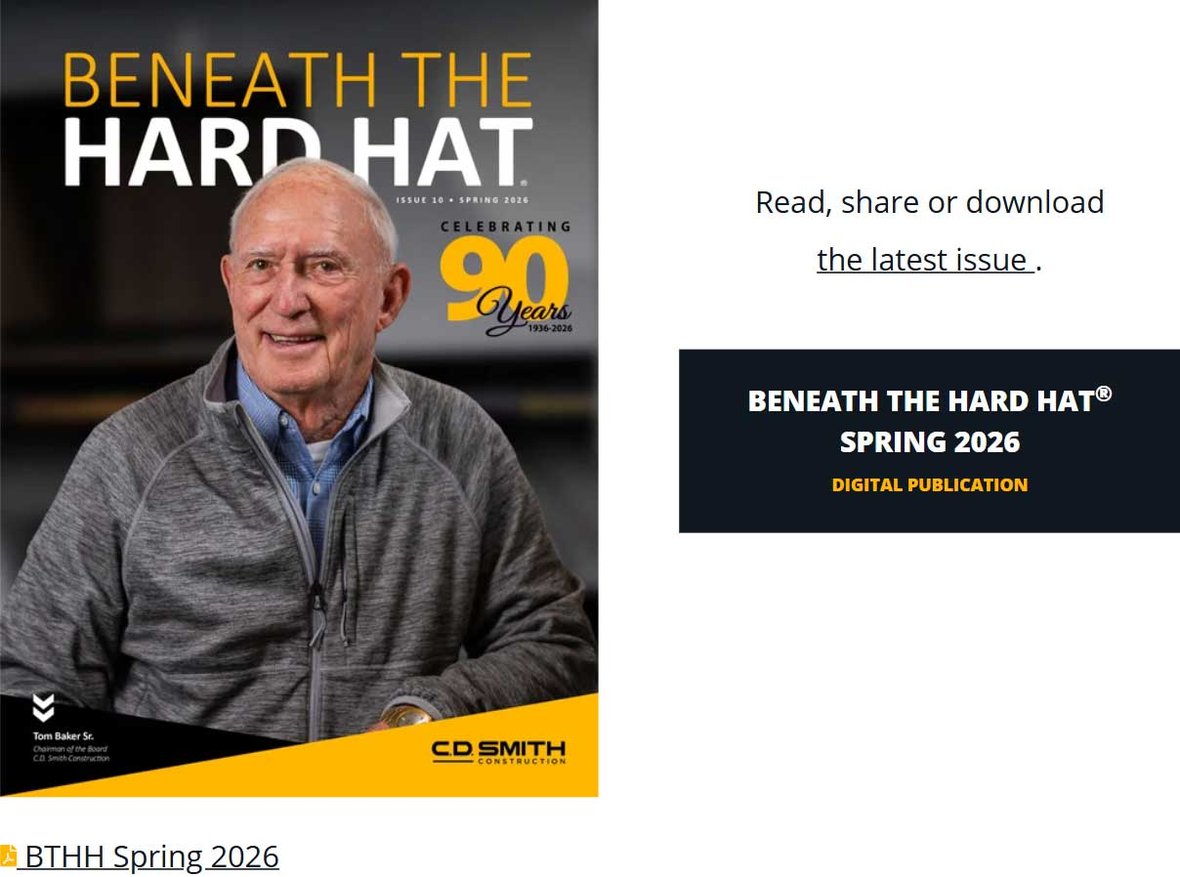
Insights from Beneath the Hard Hat® Magazine | Spring 2026
Building Through Complexity Without Disruption
Construction is getting more complex.
Facilities can’t shut down. Infrastructure can’t fail. Communities expect more. And the margin for error keeps getting smaller.
The Spring 2026 issue of Beneath the Hard Hat highlights how organizations are navigating those realities and what it takes to keep projects moving without compromising operations, safety or long-term performance.
This issue brings together real-world examples across food processing, education, healthcare, industrial and municipal infrastructure where the challenge is building while everything else continues to run.
The Real Challenge: Keeping Operations Moving
For many organizations, construction doesn’t happen in a vacuum.
- Active production environments
- Occupied healthcare facilities
- Growing communities
- Aging infrastructure systems
When Campbell Snacks’ Franklin facility needed upgrades to dust collection and venting systems, the challenge was maintaining continuous production.
No shutdown. No disruption. No compromise to safety.
That’s becoming the expectation, not the exception.
Building Inside Constraints, Not Around Them
Across industries, projects are increasingly defined by constraints:
- Limited shutdown windows
- Shared access with the public
- Aging systems that must stay online
- Tight regulatory environments
During the SSM Health Cancer Care expansion, construction took place in a residential area with shared access and active neighbors.
That changes how work gets planned.
It requires communication beyond the jobsite, logistics that account for daily life, and teams that understand impact, not just scope.
The work includes everything happening around it.
Infrastructure That Has to Last Decades
Some projects carry a different kind of pressure.
Longevity.
The City of Reedsburg faced an aging wastewater system pushed beyond capacity by time and extreme weather.
City leaders committed to rebuilding for the future.
- A new wastewater treatment facility
- Designed for resilience and long-term reliability
- Built to support current and future demand
This is long-term community investment.
Facilities That Support Growth, Not Just Space
Growth is about more than square footage. It’s about improving how a facility works.
The VerHalen industrial facility expansion reflects that shift through improved logistics, increased storage capacity and better alignment with operational needs.
Similarly, the Rosendale-Brandon School District project focuses on modern learning environments that support students, educators and future workforce development.
The question is how to build for what comes next.
Safety Is Becoming More Predictive
As projects grow more complex, so does risk.
Traditional safety practices still matter. But they’re no longer enough on their own.
AI-powered tools are now being used to:
- Identify hazards through 360-degree jobsite capture
- Flag risks with high confidence
- Connect findings directly to safety standards
- Enable faster response across multiple projects
The shift is subtle but important.
From reacting to incidents to identifying risk before it becomes one.
What This Means for Owners and Operators
Across every story in this issue, a few patterns emerge.
- Disruption is no longer acceptable. Projects must be planned around ongoing operations.
- Complexity is increasing. Projects require deeper coordination across teams and stakeholders.
- Long-term thinking is driving decisions. Durability and lifecycle performance matter more than short-term fixes.
- Technology is a multiplier. Better visibility leads to better decisions.
A Milestone That Reflects the Same Principles
This issue also marks a significant moment.
C.D. Smith Construction enters its 90th year in business with a continued focus on long-term relationships, adaptability and performance.
That milestone reflects the same themes seen across the projects in this issue.
- Consistency
- Adaptability
- Strong partnerships
- Long-term thinking
This is the kind of work that sustains organizations over time.
Read the Full Spring 2026 Issue
The Spring 2026 issue of Beneath the Hard Hat brings these stories together in more detail, highlighting the people, projects and decisions shaping today’s construction environment.
Read the full issue
«•»
Follow C.D. Smith ON SOCIAL
#CDSmith #ThinkSafeWorkSafe



Key Takeaways
- Construction increasingly requires execution without disrupting ongoing operations
- Infrastructure investments are shifting toward long-term resilience
- Facility design is focused on operational performance, not just expansion
- AI and technology are improving safety through proactive risk identification
- Successful projects depend on coordination across teams, stakeholders and environments
FAQs
What is Beneath the Hard Hat?
Beneath the Hard Hat is a construction and industry insights publication highlighting projects, partnerships and trends across multiple sectors.
What industries are featured in the Spring 2026 issue?
This issue includes projects in food processing, healthcare, education, industrial manufacturing and municipal infrastructure.
Why is building without disruption important?
Many facilities must remain operational during construction. Minimizing downtime protects revenue, safety and service continuity.
How is technology impacting construction safety?
AI-powered tools help identify risks earlier, monitor jobsite conditions and improve response times.
What should owners consider when planning complex construction projects?
Early planning, operational continuity, stakeholder coordination and long-term performance should all be prioritized.
Related Projects and Insights
- ProjectPlusFeature: Campbell Snacks Facility Upgrades
- Reedsburg Wastewater Treatment Plant
- Rosendale-Brandon School District Project
- VerHalen Industrial Facility
- SSM Health Cancer Center Expansion
- Safety and AI in Construction
- Education Construction Projects
- Civic and Municipal Infrastructure Projects